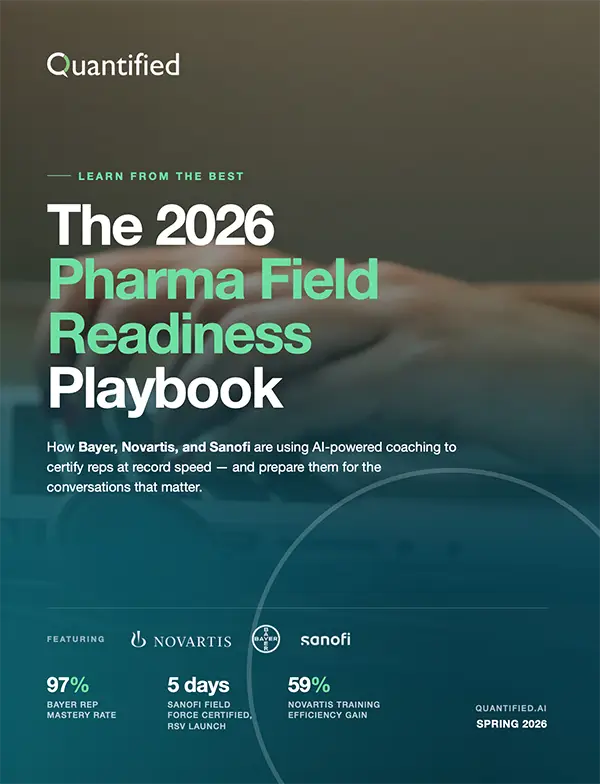
The 2026 Pharma Field Readiness Playbook
Download Now




Pharma field readiness has decoupled from training completion. A rep can finish every module in the LMS and still walk into a 12-minute HCP visit underprepared for the moment that determines whether the message lands. As HCP access has narrowed, compliance scrutiny has tightened, and launch tempos have compressed, leading commercial training teams have stopped treating completion as readiness. They certify the conversation itself: at scale, against a single rubric, before reps step into a clinic. Below is what that looks like at Bayer, Novartis, and Sanofi, and how to apply the model to your team.
Pharma field readiness is the verified ability of a sales representative to deliver an approved message, handle likely objections, and stay compliant under pressure in a live HCP conversation. It is forward-looking and conversation-specific. It is not the same as training completion, which has become a poor proxy for performance.
Modules track attendance. Field readiness tracks whether the rep can perform in the moments that matter.
Three structural shifts have made the legacy approach to readiness insufficient.
Prescriber access has narrowed meaningfully over the last decade, according to ZS Associates' AccessMonitor research. HCP engagement has shifted toward digital channels in parallel (McKinsey), and the in-person moments that remain are shorter, more selective, and more consequential. Physicians often have already reviewed the deck before the rep enters the room. The measurement layer needs an update too: see Pharma Sales Force Effectiveness Metrics: What to Measure in 2026.
MLR and legal teams scrutinize more claims with less tolerance for off-label drift. A misstated qualifier in a 20-minute visit can trigger MLR review, slow the next campaign cycle, and expose the company to regulatory action. The operational cost of a compliance miss is high.
Industry data still shows that two of every three drug launches underperform expectations. The window between FDA approval and a fully certified field force is where most of that underperformance is manufactured. Training leaders are being asked to launch faster, certify faster, and hold consistent on-label messaging across in-person, digital, and MSL-adjacent channels at the same time.
The legacy readiness playbook leans on three methods. Each was designed for an earlier set of access and compliance conditions.
Most pharma reps run a handful of roleplays per quarter. Feedback is delayed, subjective, and inconsistent across trainers. Scenarios rarely contain the regulatory and therapeutic depth a rep encounters in the room, like the progression-free survival challenge, the black-box warning concern, or the formulary decision that requires a live answer. Compliance readiness is assumed rather than tested. The compounding effect of these gaps is why traditional pharmaceutical sales training fails when reps need it most.
For two decades, the ride-along has been the closest thing pharma had to a real performance signal. The problem is that the physician is the live test. Feedback arrives after the call has already happened, from one observer, on one visit, with coaching quality entirely dependent on the manager in the passenger seat. Ride-alongs cannot scale across a launch, cannot standardize the bar, and cannot certify readiness before a rep sits in front of an oncologist for the first time. Variance is the symptom; the upstream cause is how pharma manager development gets built.
Many commercial training teams layered call-recording technology on top of roleplay and ride-alongs, hoping post-call audio would surface the data the older methods missed. The friction is real: physicians and reps both modify behavior when they know they are being recorded, and major health systems are implementing no-recording policies in the very accounts where readiness matters most. Recording is also a post-mortem discipline. If a safety warning was missed or an off-label claim was made, the violation has already reached the market. The full argument against this approach lives in The Hidden Cost of Call Recording.
None of these methods produce the practice volume, compliance signal, or coaching data a 2026 launch requires.
Three launches, three companies, the same underlying model.
Bayer's Cardio Renal & Women's Health Franchise Training team needed to certify more than 500 field representatives nationwide on a tight launch window. Live roleplay, field visits, and in-person certification could not absorb the timeline without degrading speed or quality.
Bayer rebuilt the program around AI-powered practice and a single, consistent scoring rubric.
The result: a 97 percent mastery rate across 500+ reps, with thousands of hours of trainer-led assessment redirected to coaching and pull-through. The full program story lives in How Bayer Rewrote the Rules of Sales Training With AI Roleplay.
"The ability to scale training without sacrificing quality was a game-changer for us." Peter Frank, Director, Cardio Renal & Women's Health Franchise Training, Bayer
Novartis was doubling its sales force on a compressed schedule. The traditional five-week onboarding could not stretch to fit the new hiring plan, and trainer capacity was already absorbed by operational responsibilities.
Novartis redesigned new-hire certification around AI-powered practice and automated assessment, with verbal certification absorbed off the trainers' calendars.
The result: 150+ specialists onboarded with a 95 percent first-time pass rate and a 59 percent improvement in training efficiency. The compressed timeline held. The sales force doubled. The training team did not.
"Quantified's AI personas enabled us to scale our training without pulling people out of the field." Keenan Stare, Product and Disease Training Manager, Novartis
Sanofi's RSV immunization launch had a familiar shape. FDA approval was imminent, no selling allowed until certification, and complicated certification material. Four trainers. Five hundred reps. The math did not work on the old process.
Sanofi piloted an AI-powered certification process built around the actual HCP conversations reps were about to have.
The result: 100 percent certification across the 500-rep field force, 80 percent certified within 48 hours, the remaining 20 percent within five days. Trainer time saved: roughly 250 hours, with a 3x to 5x efficiency improvement.
"With Quantified we really felt that we found our solution." Chrissy Richards, Director of Commercial Training, Sanofi
The blog covers the model. The full playbook goes deeper into how Bayer, Novartis, and Sanofi built their programs, including the launch constraints, persona design choices, scoring approach, change-management lessons, and downstream effects on coaching and pull-through.
Download the 2026 Pharma Field Readiness Playbook →
Three different launch contexts. The same three patterns.
Readiness, not completion. All three programs report outcome-based metrics: Bayer's 97 percent mastery rate, Novartis's 4.58/5 average score, Sanofi's 100 percent certification. None lead with hours trained or modules completed. That shift is what makes the data operationally useful, because managers can see, by rep, what has been demonstrated and what still needs coaching.
Consistency, not variance. Trainer-led certification produces variance. One trainer is tougher, another is gentler. Across 500 reps the variance compounds. AI coaching applies the same rubric to every rep, in the same way, every time. For pharma, consistent messaging is not a nice-to-have. Inconsistent messaging is a compliance risk, and inconsistent field readiness shows up in launch performance.
Simulation, not recording. Each program built around simulated conversations with AI personas. None chose to record live HCP calls. The compliance posture is fundamentally different. Simulated practice avoids capturing real HCP conversations, PHI, or patient-specific discussion, and it gives teams a controlled environment to catch off-label drift before reps are in the field. In a regulated industry, that is the quieter path.
The three programs were built in different organizations under different constraints. The underlying design decisions are consistent. The shift typically happens in three moves.
Most organizations still certify knowledge: training completion, module scores, knowledge checks. Leading teams certify performance: message delivery in a live scenario, handling of likely objections, compliance under pressure.
Practical start: identify the three to five conversations that determine success in your field environment. Build certification around those. Everything else should support that standard. For the case that launch readiness itself belongs on the revenue side of the ledger, see Pharma Launch Readiness as a Revenue Metric.
In most organizations, practice is bounded by trainer availability, which produces low repetition and inconsistent evaluation. Leading teams make practice available on demand, let reps iterate before certification, and simulate real HCP interactions.
This is not more practice. It is relevant practice at the moment it matters. The productivity case is the focus of Using AI to Boost Growth and Pharma Field Force Productivity.
The traditional model has managers observing, assessing, and documenting. In the new model, assessment is automated, gaps are surfaced by data, and managers spend their time coaching against specific behaviors. That is where most performance improvement happens.
The 12-Minute Test: Rethinking Pharma Field Readiness
Training completion records that a rep finished the modules assigned to them. Field readiness verifies that a rep can deliver the approved message, handle likely objections, and stay on-label in a live HCP conversation. Completion measures activity. Readiness measures outcome.
Leading pharma training teams are now certifying full field forces in days rather than weeks. Sanofi certified 500 reps for the RSV launch in five days, with 80 percent done inside 48 hours. Bayer hit a 97 percent mastery rate across 500+ reps with thousands of practice sessions absorbed off the trainers' calendars. The benchmark has moved.
Simulated practice can reduce downstream exposure compared with live-call recording because it avoids capturing real HCP conversations, PHI, or patient-specific discussion. It also gives teams a controlled environment to catch off-label drift before reps are in the field.
The most useful metrics are outcome-based: mastery rates against a defined rubric, first-time pass rates, average score on certified scenarios, certification time per rep, and, over time, pull-through performance in launch quarters. Hours trained and modules completed are activity metrics, not readiness metrics. For a deeper treatment of the measurement layer, see How to Measure Sales Coaching Effectiveness in Pharma.
AI handles assessment at scale. Managers stop running the same observation rubric across hundreds of reps and start spending their hours on the parts of coaching that require human judgment: tailoring approach to the rep, addressing the gaps surfaced by data, and reinforcing the behaviors that support stronger field execution.
No. It changes what trainers spend their time on. The Bayer, Novartis, and Sanofi programs all redirected trainer hours away from one-by-one assessment and toward higher-value work: building scenarios, refining rubrics, coaching the coaches, and shaping the next launch's program.
A modern certification program covers the conversations reps will actually have, scored against a consistent standard. The core components are:
Get those six right and the rest of the program tends to fall into place around them. Those six map directly to the three foundational must-haves we covered previously.
If you are still scoping the model. Read the full 2026 Pharma Field Readiness Playbook. It includes the full Bayer, Novartis, and Sanofi case studies, the four design decisions in detail, and a structured set of questions for evaluating your current state against the new bar. It is the reference document we wrote for commercial training leaders sitting in this exact decision.
If you are sizing it for a launch. Bring your launch calendar to a 30-minute working session with our team. We will map your current certification process against what Bayer, Novartis, and Sanofi did, surface where readiness is most likely to slip between training and the field, and give you a concrete view of what a simulation-based program would look like in your environment. Book the working session.
The benchmark has moved from weeks to days. The question is whether your next launch is built for it.